
China Frame Circuit Breakers: Essential Guide to Types, Applications, and Selection
2026-08-20
Every megawatt that flows through China's factories, hospitals, and data centers passes through a frame circuit breaker. Yet too many buyers still choose on price alone—until the first unexpected trip halts a production line and the real cost becomes painfully clear. This essential guide removes the guesswork: we break down the types (ACB, MCCB, and more), the applications where each excels, and the selection pitfalls that catch even seasoned engineers. Whether you're specifying for a new build or upgrading legacy switchgear, Chang Song brings field-proven reliability to the table. Read on to make your next breaker decision the one you never have to revisit.
How Frame Circuit Breakers Actually Work in Low-Voltage Systems
At the heart of a frame circuit breaker is a physically larger contact assembly and a spring-operated mechanism built to handle hundreds or thousands of amps without welding shut. Unlike small miniature breakers, the current path runs through heavy copper or silver-alloy contacts held closed by a toggle-and-latch system. A dedicated trip unit, either a thermal-magnetic module or an electronic relay, sits in series with the load and constantly compares actual current against adjustable pickup settings.
When current rises above the long-time pickup for an overload, a bimetal element or electronic integrator heats up and starts timing. If the overload persists beyond the selected delay, a trip coil or solenoid releases the latch and the pre-charged spring snaps the main contacts apart. For a short circuit, the trip unit bypasses the thermal path and sends an instantaneous or short-time signal, which acts in a few milliseconds. As the contacts separate, an arc forms, but magnetic blowout coils and a stack of arc chutes force the arc into thin, cooled segments until it extinguishes.
What sets frame breakers apart in low-voltage systems is the degree of adjustability and accessory integration. Current ratings can often be changed with rating plugs, and trip curves can be fine-tuned for long-time, short-time, and instantaneous regions to coordinate with downstream devices. Manual charging handles, shunt trip coils, and under-voltage releases allow remote or local operation, while the rigid frame protects internal parts from mechanical stress and lets the breaker serve as a main or feeder protection device in switchgear and distribution boards.
ACB vs MCCB: Which One Fits Your Project's Current Rating?
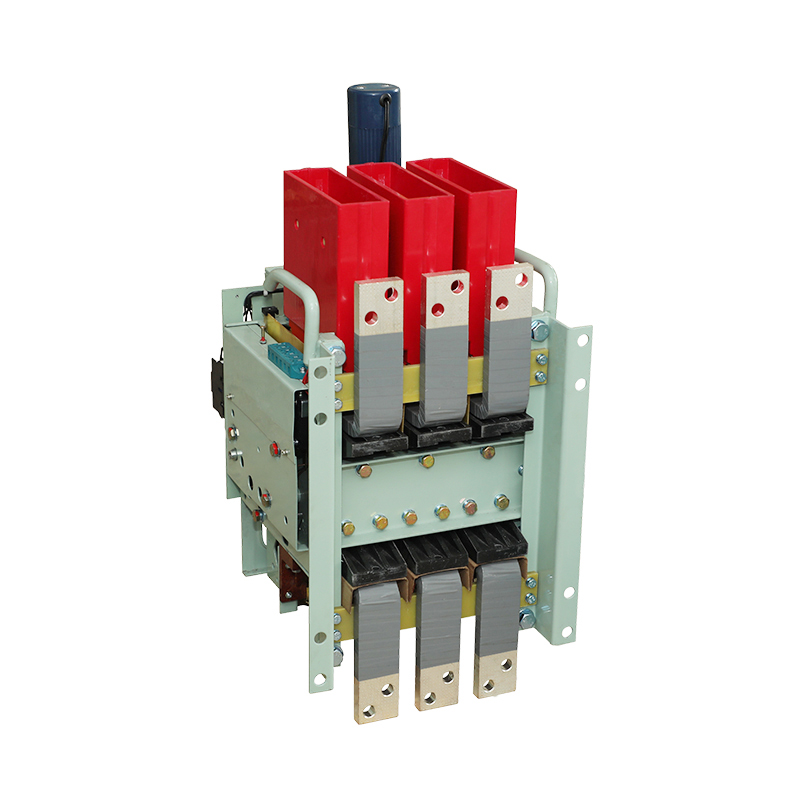
When deciding between an air circuit breaker (ACB) and a molded case circuit breaker (MCCB), the first thing to look at is the current your system actually carries. MCCBs typically handle ranges from around 15 amps up to 2,500 amps, which covers most commercial and light industrial loads. ACBs, on the other hand, are built for much heavier demands—often starting at 630 amps and going well beyond 6,300 amps. If your project’s steady-state current sits comfortably under 2,500 amps and you don’t foresee major expansion, an MCCB is usually the simpler, more cost-effective choice.
But current rating alone doesn’t tell the whole story. ACBs shine in situations where you need adjustable trip settings, high breaking capacity, and the ability to coordinate with upstream protection. Their larger physical size also makes them easier to service in place, which matters for critical facilities like data centers or hospitals. MCCBs are typically sealed units—if something fails, you replace the entire breaker rather than repair it. So if your project involves frequent overloads, high fault currents, or a need for fine-tuned protection curves, the higher current rating and flexibility of an ACB might justify the extra space and cost.
One practical way to decide is to check the available fault current at your panelboard or switchgear, not just the nominal load. A 1,600-amp MCCB may look fine on paper, but if the available short-circuit current is 65 kA or higher, you need a breaker with a matching or higher interrupt rating—often easier to find in ACB ranges. Also consider future load growth: a project that starts at 2,000 amps today might push past 3,000 amps in five years. In that case, installing an ACB with a higher frame size now avoids a costly retrofit later. For most everyday commercial fit-outs, the MCCB’s current rating is more than enough; for heavy industrial mains or large generator paralleling systems, the ACB is the safer bet.
Where Frame Breakers Earn Their Keep: Real-World Deployment Examples
Frame breakers often show up in the login flows of retail banking apps. A Nordic bank, for example, wraps its customer ID and password step with a script that checks if the page is the top window. If the check fails—say, the page is being iframed inside a lookalike domain—the script instantly replaces the parent frame with the bank's own URL. This keeps the credential fields from sitting under a transparent overlay that a phisher could use to capture keystrokes.
Another place they earn their keep is in session management portals for cloud HR systems. A global payroll provider embeds a frame-breaking routine right before the token refresh step. When an employee opens a cached link from a team chat tool that renders the page in an iframe, the breaker jumps the browser out of the frame and reloads the portal directly. That prevents stale session cookies from being reused inside a third-party context, which matters a lot when payslips and tax forms are on the screen.
Decoding Breaking Capacity: The Number Most Spec Sheets Gloss Over
Flip to the back page of any circuit breaker datasheet and you’ll find a row labeled “breaking capacity” — usually followed by a number like 10kA, 25kA, or 65kA. It sounds impressive, but most engineers never ask what that figure actually means in the real world. In short, breaking capacity is the maximum fault current the breaker can interrupt without welding its contacts shut or failing to extinguish the arc. The problem? That bold headline number is often measured under ideal laboratory conditions: a clean sinusoidal waveform, a specific power factor, and a fresh set of contacts. Your installation is never that polite.
Here’s where spec sheets quietly mislead. A breaker rated for 25kA at 480V might still fail in a location with high available fault current from a nearby transformer — not because the breaker is defective, but because the “kA” rating is only valid at a given voltage and with a short time constant. Reduce the voltage, and many breakers can actually interrupt more current. Raise it, and the number collapses. Worse, the breaking capacity is often tested as a single event. In the field, a breaker may face multiple faults over its lifetime, each one eroding the arc chutes and pitting the contacts. That 25kA rating doesn’t stay 25kA after the third short circuit.
So before you trust that spec sheet, ask three questions: What voltage was the breaking capacity measured at? What is the actual available fault current at your point of installation — not just at the service entrance? And how many times has this breaker already interrupted a major fault? If the datasheet doesn’t answer those, you’re not looking at a rating; you’re looking at a sales brochure.
China's GB Standards vs IEC: What Changes on the Nameplate
When a device moves between IEC-aligned markets and China, the nameplate rarely stays the same. Chinese GB standards often demand additional markings that go beyond what a typical IEC nameplate includes. You'll see the mandatory CCC logo, the GB standard number to which the product was tested, and usually the manufacturer's name and address in Chinese characters. That alone forces a redesign for many importers, because the IEC plate might only carry CE marking or a notified body number.
Another shift shows up in the rated parameters. GB standards can require different voltage or frequency declarations depending on the product category, and sometimes they want the rated current expressed in a way that matches Chinese grid assumptions. For example, a motor nameplate built to IEC 60034 might list duty cycle and insulation class, but the GB version could add the exact efficiency grade according to GB 18613, which doesn't map one-to-one to the IEC efficiency classes. Even the order and layout of these values can be prescribed more rigidly.
Durability and legibility rules also differ. GB tests for nameplate permanence often involve specific solvents or abrasion methods that aren't identical to IEC's general resistance requirements. A label that passes IEC rub tests might still fail GB's adhesion or weathering checks. So manufacturers don't just translate text; they need to re-qualify the plate material, adhesive, and printing method for the Chinese market.
Field Notes: Installing and Commissioning Frame Circuit Breakers Without Surprises
Most surprises with frame circuit breakers trace back to what happened before the breaker ever left the pallet. Check the alignment of the fixed and moving contacts by cycling the mechanism a few times with the breaker in the TEST position—listen for a clean, single thunk rather than a gritty double hit. Verify that the arc chutes are seated fully, and don’t trust factory torque marks until you’ve put a calibrated wrench on the primary connections. A loose bus joint won’t always show up during megger testing, but it will find you at 3 a.m. under load.
When rolling the breaker into the cradle, resist the urge to force the racking handle past the first sign of resistance. Misaligned secondary disconnects or a bent shutter can feel like normal friction. Draw the breaker out, inspect the guide rails for debris, and confirm the shutter opens symmetrically before trying again. Once the breaker is in the CONNECT position, torque the primary finger clusters in a star pattern, then recheck after the first thermal cycle. Frame breakers move slightly as they heat, and that movement will relax a joint that felt tight on a cold bus.
Commissioning is where you earn the without-surprises part. Run a primary injection test on both the short-time and instantaneous elements, not just the long-time pickup. Use a separate test set for the ground-fault function, and simulate a real phase-to-ground fault rather than injecting a balanced three-phase current. Finally, cycle the breaker electrically from a remote location while someone watches the mechanism—slow closing or a hesitation in the trip latch often indicates a spring charge issue that won’t appear on a static inspection. Log the as-found and as-left values for every setting; future troubleshooting depends on that baseline.
FAQ
Frame circuit breakers, often called air circuit breakers or ACBs, feature an open-frame construction with adjustable trip settings and higher current ratings. Moulded case circuit breakers are enclosed in a compact insulating case and typically handle lower currents. The open frame allows easier access for maintenance and adding accessories.
The main standard is GB/T 14048.2, which aligns closely with IEC 60947-2. Compliance with this standard ensures the breaker's performance for rated operational voltage, breaking capacity, and temperature rise has been verified for low-voltage switchgear.
They are commonly used as incoming or bus-tie breakers in main distribution boards for factories, commercial buildings, data centers, and infrastructure projects. Their adjustable trip units and high breaking capacities make them suitable for protecting large feeders and critical power paths.
Look at the rated current, ultimate breaking capacity, rated working voltage, number of poles, and type of trip unit. Also confirm the frame size matches the installation space and that the breaker's short-time withstand current meets downstream coordination needs.
Major suppliers include Chint, Delixi, Shanghai People Electric, Changshu Switchgear, and Tianan. International brands like Schneider Electric, ABB, and Siemens also produce frame circuit breakers in China, often under local model series.
A drawout breaker sits on a withdrawable carriage, so the main body can be racked out without disconnecting busbars or cables. This simplifies isolation, testing, and replacement. A fixed-mounted unit is bolted directly into the panel and must be fully disconnected for service.
Electronic trip units offer precise adjustable settings for long-time, short-time, and instantaneous protection, plus optional ground-fault and communication functions. Thermal-magnetic trips rely on bimetal and magnetic elements, are simpler, and cost less but provide fewer adjustment options and lower accuracy.
Yes, when equipped with appropriate trip settings. Generator protection often requires a breaker with adjustable short-time delay and reduced instantaneous pickup to coordinate with generator decrement curves. Motor protection usually uses dedicated motor circuit protectors or MCCBs, but a frame breaker can serve large motors if its trip unit is configured correctly.
Conclusion
When specifying low-voltage distribution equipment in China, frame circuit breakers often become the backbone of incoming and bus-tie positions because their draw-out construction and adjustable trip units give facilities room to grow without replacing the entire breaker. These devices interrupt fault currents by quenching the arc across multiple contacts and arc chutes, but the real decision starts well before that: choosing between an air circuit breaker and a moulded-case unit based on continuous current and expected short-circuit stress. Frame breakers earn their place in main switchboards, generator paralleling panels, and heavy industrial feeders where the load can exceed 630 A and the available fault current demands robust coordination. In a Chinese project, the nameplate data also shifts because GB standards impose different temperature rise and clearance requirements than IEC, so a breaker rated one way under IEC may carry a slightly different marking when tested to GB 14048.2.
Exact breaking capacity values, such as Icu and Ics, deserve more attention than they usually get. A breaker that can close onto a fault but cannot safely interrupt it a second time will leave the switchgear vulnerable after the first event. During commissioning, technicians should verify the mechanical interlock, the undervoltage release behaviour, and the actual short-circuit current at the terminals rather than trusting the upstream transformer label alone. Many field surprises come from mismatched control voltages or improper secondary injection settings, which are avoidable if the installation checklist includes the breaker's own trip curve and the coordination study. In the end, selecting a frame circuit breaker for a Chinese project is less about picking a familiar catalogue number and more about matching the breaker's rated operational voltage, pollution degree, and breaking capacity to the site's real conditions.
Contact Us
Contact Person: Tonglun Chen
Email: [email protected]
Tel/WhatsApp: 8618906642555
Website: https://www.cncsele.com