
China Healthcare Wristband Kiosk Terminal: Streamlining Patient Monitoring and Self-Service
2026-06-28
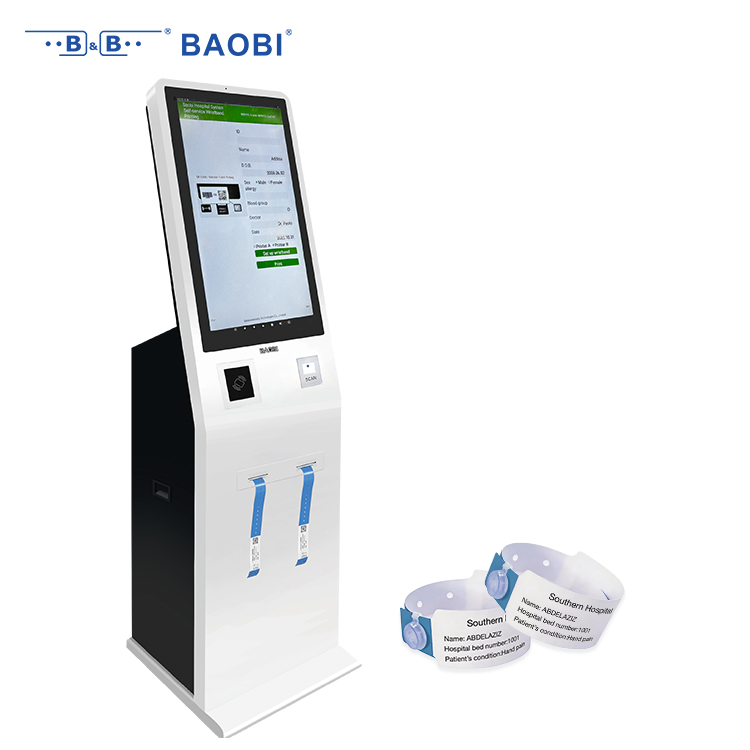
Long lines, endless paperwork, and scattered patient records slow down even the best hospitals. In China, the BAOBI healthcare wristband kiosk terminal is rewriting the rules. It merges real‑time monitoring with intuitive self‑service, turning chaotic check‑ins into smooth, data‑driven experiences. So what makes this slim terminal a game‑changer for both staff and patients? Let’s explore.
Redefining Hospital Workflows with Smart Wristband Kiosks
Long registration lines and manual data entry have long plagued hospital admissions, creating bottlenecks right at the front door. Smart wristband kiosks flip this script by allowing patients to check in, verify their identity, and receive a pre-programmed wristband in under a minute. Instead of filling out clipboards and waiting for staff to input information, patients simply scan an ID or confirmation code, and the kiosk instantly pulls up their records, prints a durable wristband encoded with critical identifiers, and syncs the data with the hospital's electronic health system. This immediate, self-driven process not only slashes wait times but also frees up administrative staff to focus on more complex patient needs.
Beyond check-in, these kiosks reshape the entire care continuum by becoming dynamic touchpoints across departments. When a nurse scans the wristband at any location—be it radiology, the lab, or the bedside—the system instantly updates the patient's status and alerts relevant teams, eliminating the need for phone calls or manual dry-erase boards. The wristband's embedded data reduces errors in medication administration and specimen labeling, while the kiosks themselves can be placed in outpatient clinics or emergency rooms to manage surges in volume without extra staffing. This seamless flow of information turns a simple band into a powerful tool that keeps the hospital agile, reduces friction in every handoff, and fundamentally redefines how care delivery unfolds from arrival to discharge.
How Wearable Tech Enhances Real-Time Patient Data Collection
Wearable devices have quietly shifted the way patient data flows into clinical workflows. Instead of relying on sporadic snapshots taken during office visits, these tools—ranging from smartwatches to chest patches—stream heart rhythms, oxygen saturation, and even glucose levels straight to care teams. The constant pulse of information means a patient’s baseline becomes visible, making subtle deviations stand out before they turn into emergencies.
Beyond the raw numbers, real-time feeds let clinicians set personalized thresholds. If a recovering cardiac patient’s heart rate spikes at 3 a.m., the system nudges the on-call nurse immediately. That kind of early nudge can prevent a frantic ER trip or a prolonged hospital stay. It’s not just about catching crises—it’s about gradually tuning treatment plans based on what the body actually does day to day.
Patients, too, gain a new sense of ownership. When someone sees how a walk around the block nudges their blood pressure in a healthy direction, those numbers stop being abstract. They become feedback loops that encourage small, daily adjustments. This quiet partnership between wearables, clinicians, and patients is slowly redrawing the boundaries of monitoring, making the hospital room less of a checkpoint and more of a safety net.
Bridging the Gap Between Self-Service and Continuous Care
Finding the right balance between letting patients handle routine tasks on their own and ensuring they receive ongoing professional attention is a subtle but vital challenge. Many digital health tools excel at either one extreme—offering a sleek portal for appointment booking or a robust telehealth platform—yet falter when it comes to creating a smooth continuum. The real magic happens when self-service options don’t feel like a dead end but rather a gateway to deeper, personalized care. It’s about designing systems where checking a lab result or refilling a prescription naturally triggers follow-up nudges, educational content, or a direct line to a care team member, all without the patient having to repeat their story.
This isn’t just about adding a chatbot or a FAQ page; it’s about weaving intelligent triage and proactive outreach into the very fabric of the patient journey. When a patient schedules a vaccine through a self-service kiosk, for example, the system can automatically schedule a follow-up message to check on side effects, or flag the record for a nurse review if the patient’s history suggests they need extra support. These handoffs between automated service and human touch are often the moments where trust is either built or broken. By anticipating needs and removing friction, healthcare organizations can foster a sense of belonging and reliability that keeps patients from falling through the cracks between visits.
Ultimately, bridging this gap means treating every self-service interaction not as a standalone transaction but as part of an ongoing relationship. It requires a blend of behavioral science, thoughtful UX, and backend integration that many vendors overlook. When done right, patients feel empowered to manage their health on their own terms, yet they never feel abandoned. They know that if a quick task turns into a serious concern, the path to a compassionate expert is just a click away—and that expert already knows what they’ve been up to. This model doesn’t just increase efficiency; it reshapes the entire care experience into something more human, responsive, and resilient.
Inside the Terminal: Design Features That Simplify Clinical Tasks
The terminal’s interface strips away everything non-essential, leaving clinicians with a clean, intuitive workspace. Large, high-contrast touch targets replace cluttered menus, while contextual toolbars surface relevant actions only when needed. This means less time deciphering the system and more time focused on the patient. The layout adapts fluidly to common workflows, so charting, ordering, and reviewing results feel like natural extensions of clinical thought rather than administrative chores.
Behind the screen, smart automation handles repetitive data entry. Voice-to-text capture transcribes notes directly into structured fields, and smart templates pre-populate based on the patient’s history and reason for visit. Clinical decision support is woven into the fabric of the interface—not as intrusive pop-ups, but as gentle nudges that appear when patterns trigger a reminder. The result is a terminal that works with the care team, quietly reducing cognitive load without interrupting the flow of care.
Interoperability features are built deep into the design, so information from labs, imaging, and specialty consults surfaces inside a unified timeline. Clinicians can glance at a single screen to see the most critical updates, rather than hunting across multiple platforms. Customizable dashboards let each provider arrange data the way their specialty demands, while retained state between sessions ensures that reopening the terminal feels like walking back into a familiar room, with everything just where it was left. It’s a tool that bends to human rhythm, not the other way around.
From Check-In to Discharge: A Seamless Patient Journey
A truly seamless patient journey starts the moment someone walks through the hospital doors. Instead of fumbling with paperwork at a crowded front desk, they’re greeted by name and guided to a comfortable waiting area where check-in happens on a tablet. The system already knows their medical history, insurance details, and reason for visit, so the conversation focuses on how they’re feeling rather than administrative trivia. This immediate sense of being known and cared for reduces anxiety and sets a positive tone for everything that follows.
As the visit progresses, every step flows naturally into the next. After a consultation, the patient doesn’t wander hallways searching for the lab—someone escorts them there, or a digital map on their phone lights the way. Test results appear in their portal before the doctor even re-enters the room, so the discussion shifts quickly to treatment options. When it’s time for discharge, a concise summary, prescriptions, and follow-up instructions are ready in one click, often sent straight to the patient’s device. They leave feeling equipped, not overwhelmed.
Behind the scenes, this smooth experience relies on integrated systems that communicate in real time—from scheduling and electronic health records to billing and post-care outreach. The patient never has to repeat their story, and nothing gets lost between departments. A quick survey or a personal phone call the next day reinforces that the connection doesn’t end at the exit. It’s a journey designed around human needs, transforming a potentially stressful event into a reassuring, coordinated whole.
The Role of Contactless Solutions in Modern Chinese Healthcare
In the rapid evolution of China's healthcare landscape, contactless solutions have transitioned from a novelty to a necessity, reshaping patient journeys with quiet efficiency. From the moment a person steps into a hospital, their experience is often mediated by a symphony of QR codes, NFC taps, and facial recognition gates—bypassing the crowded registration desks that once symbolized the grinding wait times of public hospitals. This shift isn't simply about technology adoption; it's a cultural recalibration toward minimizing physical touchpoints in environments where cross-infection risks are magnified, while also tackling the systemic strain of serving a population of 1.4 billion. The seamlessness of these systems often masks the intricate backend integration with provincial health platforms, electronic medical records, and even government-issued digital IDs, creating a flow that feels almost intuitive despite its complexity.
What sets China apart is the scale and pace of implementation, fueled by a unique mix of policy push and consumer readiness. During the pandemic, contactless fever screening, AI-driven triage bots in WeChat mini-programs, and drone-delivered medication to quarantined communities became visible proof points. Today, these innovations have matured into permanent fixtures: smart kiosks that dispense prescriptions after a virtual consultation, or inpatient wards where meals and medications arrive via autonomous carts, and vital signs are monitored through wearable patches that update cloud records without a nurse’s direct intervention. The undercurrent here is the way these tools dissolve language and mobility barriers for the elderly and rural populations, a demographic often sidelined by digital-first designs. Voice-assisted registration and tap-to-pay systems linked to social insurance cards are bridging gaps rather than creating them, quietly rebuilding trust in a system that had long battled perceptions of inaccessibility.
Beyond operational efficiency, the deeper narrative lies in data continuity and preventive care. Every contactless interaction feeds into a unified health profile, enabling automated appointment reminders, prescription refills, and early warnings for chronic conditions without a single phone call. In cities like Shenzhen and Hangzhou, community health centers now use contactless blood pressure monitors that transmit data directly to municipal health databases, triggering follow-up text messages when readings spike. This ecosystem turns sporadic hospital visits into a continuous care loop, reducing acute episodes. Yet, it also quietly rewrites the patient-doctor relationship—consultations are now often a culmination of what the system already knows, shifting the dialogue from bland questioning to targeted advice. The real success isn't in the gadgets themselves, but in how seamlessly they fade into the background, making healthcare less about the process and more about the outcome.
FAQ
It serves as a dual-purpose solution that integrates patient monitoring with self-service capabilities, allowing hospitals to automate check-ins, track vital signs, and give patients direct access to their own health data.
The wristband syncs wirelessly with the kiosk. Once issued, it continuously monitors parameters like heart rate, temperature, and activity, then uploads the data securely when the patient taps the terminal.
A patient approaches the kiosk, verifies identity, and receives a personalized wristband. The band then tracks them throughout their visit, while the kiosk serves as a hub for updating records, making payments, and receiving real-time alerts.
It cuts waiting times dramatically by handling registration, insurance verification, and preliminary vitals capture all in one spot, reducing the administrative load on nursing staff.
Yes, both components use encrypted data transmission and role-based access controls. Patient records are stored in compliance with China's healthcare privacy regulations, and biometric authentication is available on the terminal.
Absolutely. The kiosk's software can be tailored to specialties like cardiology, geriatrics, or pediatrics, adjusting the vitals tracked, alerts thresholds, and on-screen instructions accordingly.
Pilot hospitals report a noticeable drop in overcrowding at reception areas and higher patient satisfaction scores, especially among elderly users who find the guided touchscreen interface simpler than talking to multiple clerks.
Conclusion
The healthcare wristband kiosk terminal is reshaping how Chinese hospitals manage patient flow, turning a traditionally chaotic check-in process into a calm, self-guided routine. Patients receive a smart wristband at the kiosk that pairs instantly with hospital systems, feeding real-time vitals and location data to nursing stations. This continuous stream of information helps staff catch subtle changes early, while reducing manual rounds. The design itself focuses on simplicity: large touchscreens with clear icons, contactless ID scanning, and instant print-and-wear bands that need no pairing or apps. From arrival to discharge, every step is connected—the same wristband handles admission, records medication times, and even unlocks bedside services, creating a truly seamless experience.
Behind the scenes, the terminal bridges a critical divide between self-service convenience and uninterrupted clinical oversight. Wearable sensors embedded in the band track temperature, heart rate, and movement patterns, updating electronic records automatically without nurses having to chase down readings. This contactless approach proved especially valuable in crowded outpatient settings, where minimizing physical touchpoints cuts cross-infection risks. At the terminal, patients can also update their own symptoms or allergies, which instantly alerts care teams to potential red flags. The result is a system that doesn't just speed up paperwork but actively participates in patient monitoring, turning a simple wristband into a quiet, round-the-clock care companion.
Contact Us
Contact Person: Bill Xu
Email: [email protected]
Tel/WhatsApp: 8618688898707
Website: https://www.baobitech.com/