
China Stainless Steel Carriage Bolts: A Buyer's Guide to Quality and Sourcing
2026-10-15
Sourcing stainless steel carriage bolts from China can feel like navigating a maze of suppliers, grades, and hidden compromises. Whether you're a procurement manager or a DIY enthusiast tackling marine or outdoor projects, the wrong choice leads to rust streaks, stripped threads, or costly replacements. That's why we've put together this buyer's guide: to cut through the noise and focus on what actually matters—material certifications, head markings, plating consistency, and supplier reliability. At the heart of a trustworthy supply chain is Wanluo, a name that stands for rigorous quality checks and transparent sourcing. No fluff, no recycled spec sheets—just the practical insights you need to make an informed decision. Read on to learn how to spot genuine 304 vs. 18-8, ask the right questions before placing an order, and avoid the most common pitfalls that cost buyers time and money.
Grades That Actually Resist Corrosion in Coastal and Industrial Settings
The usual 'stainless steel' label doesn't mean much when salt spray and chemical fallout are part of the daily weather. In coastal zones, chloride ions eat through standard 304 surfaces within months, leaving behind rust blooms that look more like neglect than engineering. What actually holds up are grades with higher molybdenum content—316 and its low-carbon variant 316L—because that extra alloying element binds with the chromium oxide layer and makes it far less likely to break down under pitting attack. But even those can struggle in heavy industrial areas where sulfur dioxide and nitrogen oxides mix with marine humidity, which is why duplex and super duplex grades have quietly become the go-to for structural brackets, handrails, and cladding near ports and chemical plants.
What separates a genuinely corrosion-resistant grade from a marketing claim is not just its composition but how it behaves in the micro-environments that real installations create. For example, welds and heat-affected zones are almost always the first failure points because sensitization strips away the passive layer exactly where stress concentrates. Choosing a low-carbon or stabilized grade—like 316L, 2205, or 904L—is not about chasing a bigger number on a spec sheet; it's about preventing that thin, invisible oxide film from becoming porous when it matters most. In practice, that means fewer shutdowns for cosmetic repair and less hidden degradation behind sealants and joint covers.
The best material selection for coastal and industrial exposure rarely comes down to a single perfect alloy. It comes down to matching the grade to the specific failure mode: 316L for general salt-laden air where regular washing is possible, 2205 duplex for load-bearing components exposed to both chlorides and mechanical stress, and 6% molybdenum super austenitics or even nickel alloys for splash zones and chemical-laden condensate. Many specifiers overpay for exotic metals when a well-chosen duplex would outperform at a lower cost, simply because they focus on the name instead of the actual corrosion mechanism. The grades that resist are the ones chosen by engineers who treat corrosion not as a checkbox but as a local weather system the metal has to live in for decades.
How to Read a Mill Certificate for Chinese Stainless Carriage Bolts
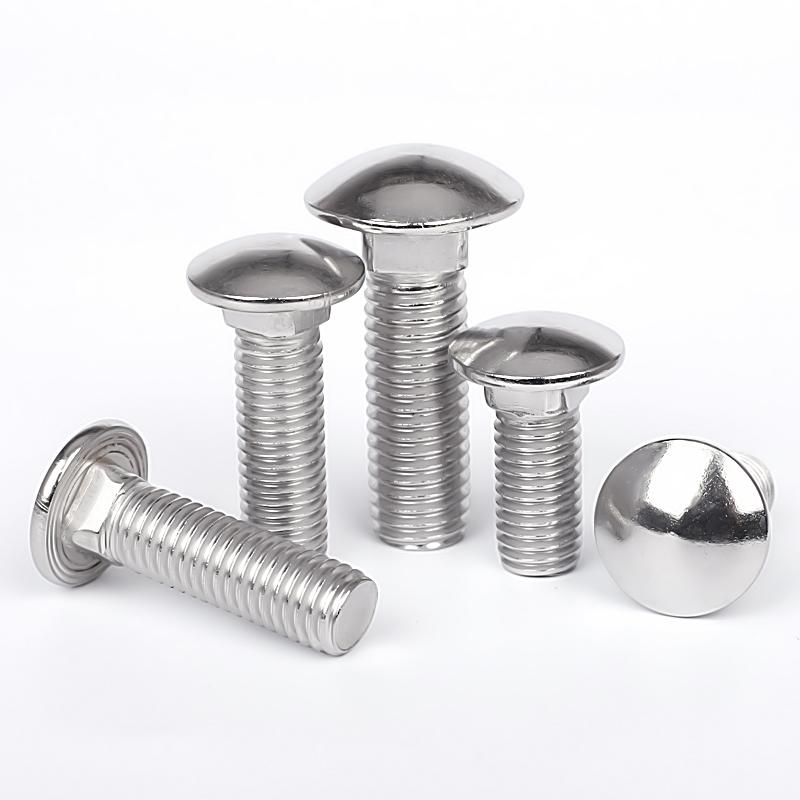
Start with the heat number and the ladle analysis. A Chinese mill certificate for stainless carriage bolts usually lists the exact grade—304, 316, or occasionally 201—alongside a heat number that ties the bolts back to a specific melt. Match that number against the markings on the bolt packaging or the inspection lot. If the certificate shows a different heat or a vague range, treat it as a red flag. The chemical breakdown should include chromium, nickel, molybdenum (for 316), and carbon. For 304, expect chromium around 18% and nickel around 8%; for 316, molybdenum should sit close to 2%. Small deviations are normal, but carbon above 0.08% for 304 or 316 can hurt corrosion resistance and weldability.
Next, look at the mechanical properties and the standard cited. Chinese mills often reference GB/T 3098.6 or ISO 3506 for stainless fasteners, and the certificate should state the bolt class—A2-70 or A4-80, for example. Check the tensile strength, yield strength, and elongation values against the class requirement. A2-70 needs a minimum tensile strength of 700 MPa and a 0.2% proof stress around 450 MPa; if the numbers are missing or handwritten without a lab stamp, ask for a retest. Also verify the certificate's issue date and the signature or chop from the mill's quality department. A real certificate usually carries a unique document number you can cross-check with the supplier.
Finally, confirm the surface condition and any supplementary tests. Carriage bolts are often used in visible or damp locations, so the certificate may mention passivation, pickling, or a specific finish. Some Chinese mills add salt spray test results or intergranular corrosion tests—these are not universal, so if your application demands them, check that the certificate actually lists the test method and result, not just a general statement. Keep in mind that a mill certificate describes the raw material or finished fastener at the time of testing; it does not guarantee what happens after long storage, secondary machining, or improper installation. When in doubt, order a small sample and have an independent lab verify the key values.
Spotting Suppliers Who Own Their Heading and Threading Equipment
Walk the floor and ignore the polished brochure shots. Ask to see the heading and threading machines under power, and pay attention to the nameplate details—year of manufacture, serial numbers, repair tags. If a supplier hesitates about where the equipment sits, or the machines happen to be idle every time you visit, treat that as a warning sign.
Another clue comes from the people running the process. A factory that genuinely owns and operates this gear can tell you about die life, the usual failure points, and how they adjust punch speed for different alloys. They will even complain about a particular machine's quirks. Vague claims about 'advanced equipment' without those specifics usually point to a middleman.
Watch the flow of work in progress. Shops with in-house heading and threading form a continuous internal sequence, so you will not see bins of semi-finished parts sitting in an outsource staging area for days. The material moves from one station to the next in a rhythm that matches the shift schedule, and you rarely spot third-party logistics labels on the floor.
Visual Clues That Reveal Poor Passivation or Rough Shank Finishes
A quick glance at the shank under angled light often exposes what a casual inspection misses. Poor passivation shows up as patchy discoloration—think faint brown tea stains near the thread roots or a dull, milky haze that refuses to reflect light evenly. These aren't uniform like a deliberate coating; they wander, fading in and out as if the acid bath never fully reached certain areas. On stainless fasteners, you might also catch a rainbow-like tint near the head or along the shank, a sign that heat or chemical residue was left to linger instead of being rinsed clean.
Rough shank finishes have their own visual signature. Run a fingernail along the surface and you'll feel the chatter marks before you see them, but under a bright light they appear as fine, repeating ridges or a crosshatch pattern that shouldn't be there. Some shanks show a gritty texture, almost like fine sandpaper, where the metal was torn rather than cut smoothly. Look for tiny pits or open grain lines—little dark specks that catch shadows and don't polish out. These defects often cluster near the transition from shank to threads, where tool pressure changes abruptly.
Another tell is inconsistent reflectivity across the same batch. Hold two fasteners side by side: one might have a soft, satin-like sheen while its neighbor looks streaky or even slightly frosted. That variation points to uneven media blasting, worn tooling, or a passivation line running too fast. In severe cases, you'll notice a faint orange bloom on the shank's surface—not full rust, but an early warning that the passive layer never formed properly. These visual clues matter because they foretell corrosion resistance and fatigue performance long before any lab test would flag a problem.
Batch Testing Requests That Separate Serious Mills from Resellers
A request for a small batch test run does more than verify material specs—it exposes how a supplier thinks. A real mill will ask about end-use conditions, tolerance expectations, and downstream processing steps before quoting. They want to know if the trial order makes sense for their equipment and whether they can actually hit the numbers.
Serious mills respond with data, not discounts. They might send you a production sample from a similar grade already running, suggest a slightly adjusted spec to improve consistency, or propose a split run to compare two formulations. The conversation stays technical: viscosity curves, particle size distribution, cure time under load. That level of engagement is hard to fake.
Resellers tend to go quiet when pressed for batch-level detail. They’ll promise “same as before” or loop in a third party, but cannot answer why a certain additive percentage changed or how they control moisture during blending. You’ll hear about lead time and freight far sooner than you’ll hear about tensile strength or melt flow index. That silence is the real signal.
Locking Down Lead Times, Packaging, and Payment Before Sampling
A vague lead time of “around 30 days” is useless when you’re planning inventory. Ask the supplier to break it down: raw material procurement, cutting and sewing, printing, assembly, and final inspection. Get exact dates for each stage, not just a final shipment day, and pin down whether weekends and local holidays are included. If the factory is running at 80% capacity, that 30 days could easily become 45. Put the schedule in writing, with a penalty clause for delays exceeding a set grace period—this forces the supplier to think realistically before you commit to sampling fees.
Packaging often gets treated as an afterthought until a rework charge appears on the invoice. Lock down every detail before the sample leaves the factory: inner box dimensions, master carton weight limit, corrugated board grade, moisture barrier requirements, label placement, and palletization pattern. If you’re shipping to Amazon or a retail DC, missing a small spec like a suffocation warning label can trigger a rejection at the dock. Suppliers will default to “standard export carton” unless you give them a measurable spec sheet—and once the sample is approved, don’t let them silently change the packaging to save cost.
Payment terms are easiest to negotiate before you’ve seen a sample, not after you’re already emotionally invested. Clarify the deposit percentage, when the balance is due, the payment method, and who absorbs bank transfer fees or currency conversion losses. If there’s a sample fee, ask whether it’s refundable against the bulk order and who pays for courier shipping. Also agree on a third-party inspection clause tied to the pre-shipment sample, so you’re not arguing about defects after the container has sailed. Getting this written into the proforma invoice now prevents a standoff later when the supplier suddenly wants 70% upfront.
FAQ
Focus on the grade of stainless steel—304 and 316 are common, with 316 offering better corrosion resistance for marine or acidic environments. Check the thread consistency, head shape, and square neck dimensions, as these affect fit. Ask for mill test certificates to confirm the alloy composition rather than relying on a visual check.
Yes, DIN 603 and ISO 8677 are the most widely recognized dimensional standards for carriage bolts. For material properties, refer to ISO 3506 for stainless steel fasteners, which defines grades like A2 and A4. Providing these references upfront helps suppliers quote accurately.
Request a pre-production sample and, if possible, arrange a third-party inspection of the factory. Look for evidence of in-house heading, thread rolling, and passivation. A supplier that handles these steps internally usually has tighter control than one that outsources multiple processes.
Most stainless carriage bolts come with a bright or polished finish, but you may also see passivated finishes to enhance corrosion resistance. Avoid painted or coated finishes unless specifically needed—stainless steel is valued for its natural oxide layer, and heavy coatings can hide lower-grade material.
MOQs often range from 1,000 to 10,000 pieces per size, depending on the diameter and length. Smaller custom sizes might have higher thresholds. It’s worth discussing whether the supplier can combine multiple sizes in one container to meet the MOQ without overstocking one dimension.
Choose A4 (316) stainless steel rather than A2 (304) if the bolts will face salt spray or industrial pollutants. Specify a passivation treatment after machining. Also confirm that washers and nuts match the same material grade—mixing 304 bolts with 316 nuts can create galvanic issues in the long run.
Be cautious of prices significantly below the market average, vague answers about raw material origin, or reluctance to share production photos. A common issue is substituting lower-nickel stainless steel, which is magnetic and rusts quickly. A simple magnet test can help, though it’s not a definitive quality check.
Many Chinese manufacturers can adjust lengths and stamp custom head markings with minimal setup costs, especially for orders over a few thousand pieces. Tooling for non-standard head shapes is more expensive, so try to keep the head design within DIN or ISO profiles to avoid extra charges.
Conclusion
Sourcing stainless steel carriage bolts from China demands attention to details that most generic checklists miss. Start with grades that actually hold up in coastal or industrial environments—look beyond the standard 304 and ask for 316 or 316L where chloride exposure is constant. A mill certificate is only useful if you know how to read it: verify the heat number, trace the composition against the claimed grade, and confirm the certificate comes from the actual mill, not a middleman's letterhead. Suppliers who own their heading and threading equipment tend to have tighter control over dimensional consistency, so probe whether they run these operations in-house or sub them out.
Once you have a shortlist, rely on visual and physical checks before committing to a container. Poor passivation often shows up as uneven discoloration or a dull, blotchy surface; a rough shank or burred threads suggest skipped finishing steps. Request batch testing that goes beyond a simple certificate—ask for salt spray results, tensile and yield data, and a sample from the exact production lot you will receive. Finally, lock down lead times, packaging specs, and payment terms before you pay for samples, because resellers often promise flexibility but cannot guarantee production scheduling. Serious mills will commit to a clear timeline and proper sea-worthy packaging.
Contact Us
Contact Person: Shane
Email: [email protected]
Tel/WhatsApp: 8613357785029
Website: https://www.wanluohardware.com
