
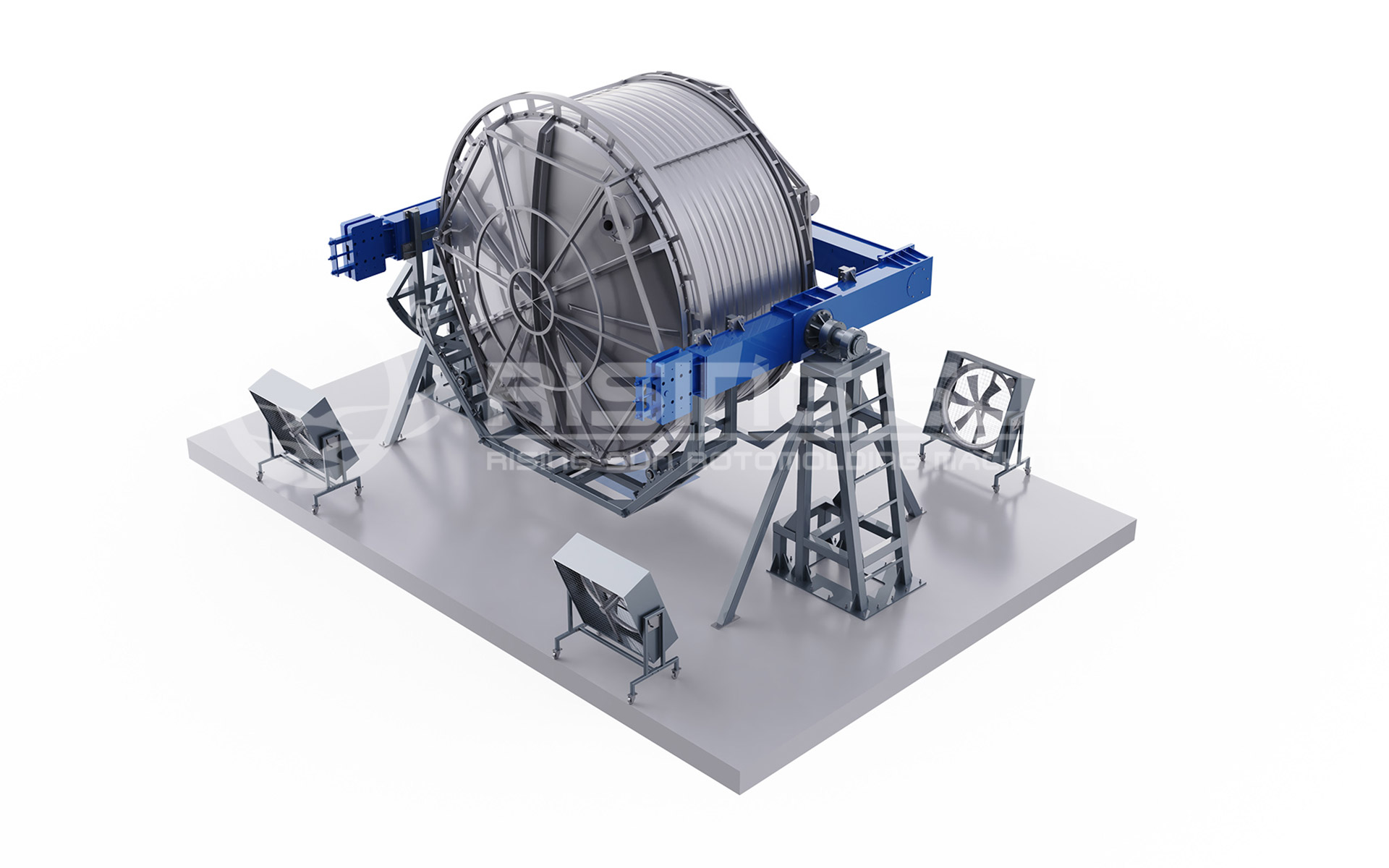
U-Arm Open Flame RR Machine Manufacturer: Crafting Reliable High-Temperature Systems
2026-09-24
What separates a machine that survives the flames from one that merely exists in them? For the U-Arm Open Flame RR Machine from Rising Sun, the answer lies in every weld, every sensor, and every test cycle. This isn't another spec-sheet promise—it's how we've redefined reliability in high-temperature systems. Keep reading to see the engineering choices that keep our equipment running when others shut down.
The U-Arm Geometry That Keeps Flames Steady Under Load
The U-arm's curved profile isn't just a stylistic choice. Under load, the two parallel legs and the connecting cross-member distribute mechanical stress more evenly than a straight bracket would. This reduces micro-deflections at the mounting point, so the burner head or nozzle stays locked in its intended orientation even when surrounding components flex from heat or pressure.
What matters most is the torsional stiffness the U-shape brings. A flame that flickers or drifts when equipment vibrates usually points to a support structure that's twisting under asymmetric loads. The closed-loop geometry of the U-arm resists that twist, keeping the fuel-air mix point fixed. As a result, the flame envelope remains stable and centered rather than wandering toward cooler zones or edges.
There's also a thermal benefit that tends to get overlooked. The U-arm's open center allows airflow to circulate around the back side of the burner, pulling heat away from the arms themselves. That keeps thermal expansion more uniform, so the geometry doesn't warp enough to shift the flame angle during extended operation.
Burner Arrays Tuned for Even Heat Distribution
Most burner layouts fail because they treat every flame port as identical. When you space ports evenly and drill them to the same depth, the outer edges get starved while the middle runs hot. A properly tuned array varies port diameter along the manifold, using slightly smaller holes near the inlet and larger ones toward the far end. This compensates for pressure drop and keeps the gas velocity consistent, so a pan placed anywhere across the grate sees the same infrared glow.
Tuning also means paying attention to the burner's cross-section. A flattened oval shape with a slight taper encourages the air-fuel mix to spread before it exits, reducing hot spikes where flames crowd together. Some manufacturers run the array through thermal imaging after assembly, adjusting the inner baffle by a few millimeters to eliminate cold corners. That kind of fine-tuning is invisible on a spec sheet, but you'll notice it the first time you toast a tray of nuts without stirring.
On the practical side, look for burner arrays with individually replaceable port sections. They allow you to rebalance the system after a year of use, when a few ports inevitably widen from heat cycling. Cleaning should be straightforward too: the trough beneath the ports needs a gentle slope toward a drip channel, otherwise boiled-over liquids pool and alter the flame pattern. Even heat distribution is less about a single design trick and more about these small, deliberate choices that keep every square inch working at the same intensity.
Materials That Laugh at Thermal Cycling
Thermal cycling has a way of exposing weaknesses—joints crack, interfaces delaminate, and coatings peel away after enough expansion and contraction. Yet a handful of materials seem almost amused by the whole process. They don't resist temperature swings so much as absorb them, redistributing strain through microstructures that flex instead of fracture. The result is a component that shrugs off hundreds or thousands of cycles while its conventional counterparts quietly fall apart.
Take certain ceramic matrix composites, for example. Their fiber-matrix interfaces are deliberately weakened enough to let cracks wander sideways, blunting the energy that would otherwise rip through a monolithic ceramic. Some shape memory alloys handle thermal stress by shifting between crystallographic phases almost reversibly—like a door that swings both ways without wearing out the hinges. Even a few polymer systems manage it by building in sacrificial bonds that break and re-form, keeping the bulk material intact.
This isn't about making something invincible. It's about accepting that thermal stress is inevitable and designing materials that treat it as background noise rather than a death sentence. Aerospace engineers, power plant operators, and electronics designers are all paying attention, because a material that laughs at thermal cycling means fewer replacements, less downtime, and a lot fewer unpleasant surprises during a cold start or a hot shutdown.
Real-Time Monitoring Without Operator Guesswork
Operators often rely on intuition or delayed reports to gauge system health, but this approach leaves room for costly oversights. Real-time monitoring shifts the focus from reactive guesswork to proactive clarity, presenting live data streams that reflect actual conditions as they evolve. Instead of wondering whether a threshold has been crossed, teams see it happen the moment it occurs, enabling immediate, informed decisions.
The value lies in removing ambiguity from day-to-day operations. Continuous visibility into pressure, temperature, flow rates, or equipment status means anomalies surface before they escalate into failures. No more cross-referencing outdated logs or second-guessing sensor readings—every relevant metric appears on a unified dashboard, updated without refresh cycles or manual polling.
This approach also changes the nature of operator training and response protocols. With transparent, always-current data, personnel spend less time interpreting what might be happening and more time executing confident actions. The result is fewer false alarms, reduced downtime, and a work environment where certainty replaces speculation.
Maintenance Points You Can Reach Without a Full Teardown
Many routine fixes hide behind small covers and quick-release clips, not buried under layers of engine components. You can swap the air filter, inspect the serpentine belt for cracks, and clean a gummed-up throttle plate without draining coolant or removing the intake manifold. A bright flashlight and a basic socket set are usually enough to reach these spots.
Fluid checks are another easy win. Transmission dipsticks, power steering reservoirs, and brake fluid caps sit right on top on plenty of models. Wipe the dipstick, read the level with the engine warm, and top off only with the exact spec listed on the cap or in the owner’s manual. Catching a slow leak early here beats finding metal glitter during a rebuild.
Don’t overlook the electrical side. Battery terminals corrode slowly, and ten minutes with a wire brush and some anti-corrosion pads can prevent a no-start on a cold morning. Ground straps near the fender and the main engine ground are often visible without lifting the car—tightening one loose bolt can fix a rough idle or intermittent sensor codes.
Tailoring the RR Machine to Your Furnace Setup
Every furnace behaves a little differently, so treating your RR machine as a one-size-fits-all tool usually ends in frustration. Start by checking the distance between the heat source and the material bed—too close and you'll scorch the surface; too far and the reaction stalls before it starts. A good rule of thumb is to run a short calibration cycle with a scrap piece, then adjust the machine's power curve based on how evenly the temperature spreads across the work zone.
The airflow pattern inside your furnace matters more than most people realize. If you have a bottom-up draft, angle the RR machine's exhaust vent slightly downward to avoid turbulence that can shift the reaction zone. For side-draft setups, keep the machine parallel to the airflow and leave at least a hand's width of clearance on the intake side. Small tweaks like these prevent hot spots and keep the cycle time consistent from batch to batch.
Don't forget to match the machine's clamping pressure to the thickness of your furnace walls. Thicker insulation calls for a gentler grip, while thin-walled chambers may need a firmer hold to avoid vibration. Once you've dialed in these details, log the settings somewhere visible near the controls—future you will thank you when the next material change doesn't send you back to square one.
FAQ
It’s an industrial heating unit built around a U-shaped arm that delivers a direct open flame, primarily used for rapid, uniform temperature application in heavy-duty processing lines.
Steel mills, forging plants, glass tempering facilities, and metal heat-treatment shops commonly use these machines where consistent flame contact is essential for throughput.
The U-arm allows the flame to wrap around the workpiece from multiple angles, reducing cold spots and improving thermal uniformity without needing extra rotating fixtures.
They use specially alloyed burner tips, reinforced arm joints, and controlled cooling channels in the arm structure, which lowers stress cracking and extends maintenance intervals.
Customers can specify arm length, flame intensity zones, and nozzle spacing, so the machine matches the exact conveyor speed and material thickness of their line.
Flame detection sensors, automatic fuel shutoff valves, and pressure monitoring on the gas train are standard, with optional exhaust gas temperature alarms for enclosed installations.
Each burner is tuned with a dedicated air-fuel ratio controller that compensates for draft variations and humidity, keeping the flame shape steady without manual adjustments.
Daily checks focus on nozzle cleanliness and gas pressure, weekly checks cover arm alignment and flame sensor calibration, and quarterly inspections examine the refractory lining and valve seats.
Conclusion
The U-Arm geometry on this open flame RR machine does more than support the burner assembly—it redirects combustion gases so the flame stays anchored even when the furnace cycles through heavy loads. Pair that with burner arrays that are individually trimmed for even heat distribution, and you get a heating profile that doesn't favor one side of the workpiece over the other. The materials specified for the hot face and structural components are chosen specifically because they tolerate rapid thermal cycling without cracking or warping. That combination means fewer hot spots, less rework, and a longer service life for the entire system.
Operators aren't left guessing with this equipment. Real-time monitoring captures temperature and flame stability data continuously, flagging deviations before they become problems. When service is needed, the design places access points on the front and sides so routine inspection, burner tip changes, and thermocouple replacement can be done without a full teardown. And because furnace layouts vary, the RR machine is configured around your specific setup—whether that involves custom mounting brackets, adjusted flame lengths, or integration with existing control logic. The result is a high-temperature system that feels less like a generic product and more like a purpose-built extension of your operation.
Contact Us
Contact Person: Sharon Zhu
Email: [email protected]
Tel/WhatsApp: 8615712666272
Website: https://www.risingsunroto.com
